
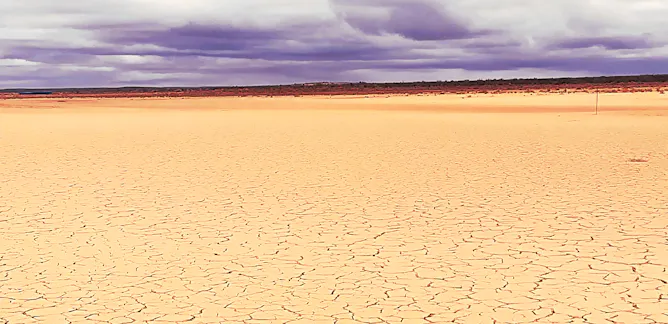
South Africa’s driest regions rely on groundwater, which dries up as the climate warms. Replenishing aquifers with excess rainfall may be a solution.

The University of the Free State (UFS) is increasingly being seen as an exciting scholarship destination, as evidenced by an unprecedented level of interest by academics and students from around the world. The changes taking place at the university continue to capture the imagination of people everywhere, including the international media and our growing base of international universities.
One of the reasons for the broader interest in the UFS is our very public commitment to the highest academic standards. In doing so, the university pursues a vision of uplifting standards for students and academics alike despite the challenges young people encounter in the school system. We believe strongly that given the opportunity, all young people can achieve the high standards set by our university. This is our academic project.
The UFS remains conscious, however, of its responsibility for public scholarship, for turning ideas into action, for making research count in the lives of ordinary people and for developing a spirit of service through scholarship among our students. These students are the next generation of leaders in South Africa, on our continent, and in this global, interconnected world. In these pursuits, the university seeks to distinguish itself from its competitors. Few universities, for example, make human reconciliation one of the foundations of its mission. This is our human project.
With its central campus situated in Bloemfontein, the capital of the Free State province, the UFS is one of the oldest institutions of higher education in South Africa. It opened its doors in 1904 with a mere six students in the Humanities and has since grown to more than 30 000 students spread across seven faculties. Besides the Bloemfontein Campus, the university also has a South Campus in Bloemfontein.
Bloemfontein is not only the birthplace of major political parties that shaped the political landscape in South Africa. The city has also produced some of the leading minds in teaching, medicine, agriculture, science, theology, economics, management and many other fields. We are particularly proud of the legal minds cultivated in the university and in the city, the home of the Supreme Court of Appeal.
The UFS also has a vibrant Qwaqwa Campus in the Eastern Free State serving rural students from the immediate area and surrounding provinces, and a smaller South Campus in Bloemfontein that provides alternative access to higher education for promising students who obtained poor marks in their final school examinations.
The university’s seven faculties with more than 130 departments and/or schools are served by more than 1692 academic staff members, supported by a strong administrative and support staff.




Univertsity Assistant (Postdoc), Universität Wien; University of the Free State
Senior Professor (Emeritus) and Research Fellow, Department of History, University of the Free State
Professor: Centre for Environmental Management, University of the Free State
Senior lecturer in Economics, University of the Free State
PhD Candidate in the Centre for Environmental Management, University of the Free State
Lecturer and researcher: Centre for Teaching and Learning, University of the Free State
PhD Candidate in the Institute for Groundwater Studies, University of the Free State
Lecturer in Department of Mercantile Law at the Faculty of Law, University of the Free State
Senior lecturer/ Co-Director, University of the Free State
Senior Lecturer, University of the Free State
Desert Ecology Research Associate, South African Environmental Observation Network, Centre for Environmental Management, University of the Free State
Associate Professor, Mathematical Statistics and Actuarial Science, University of the Free State
PhD candidate, University of the Free State
Associate Professor in the Centre for Environmental Management, University of the Free State
Research Fellow, University of the Free State